


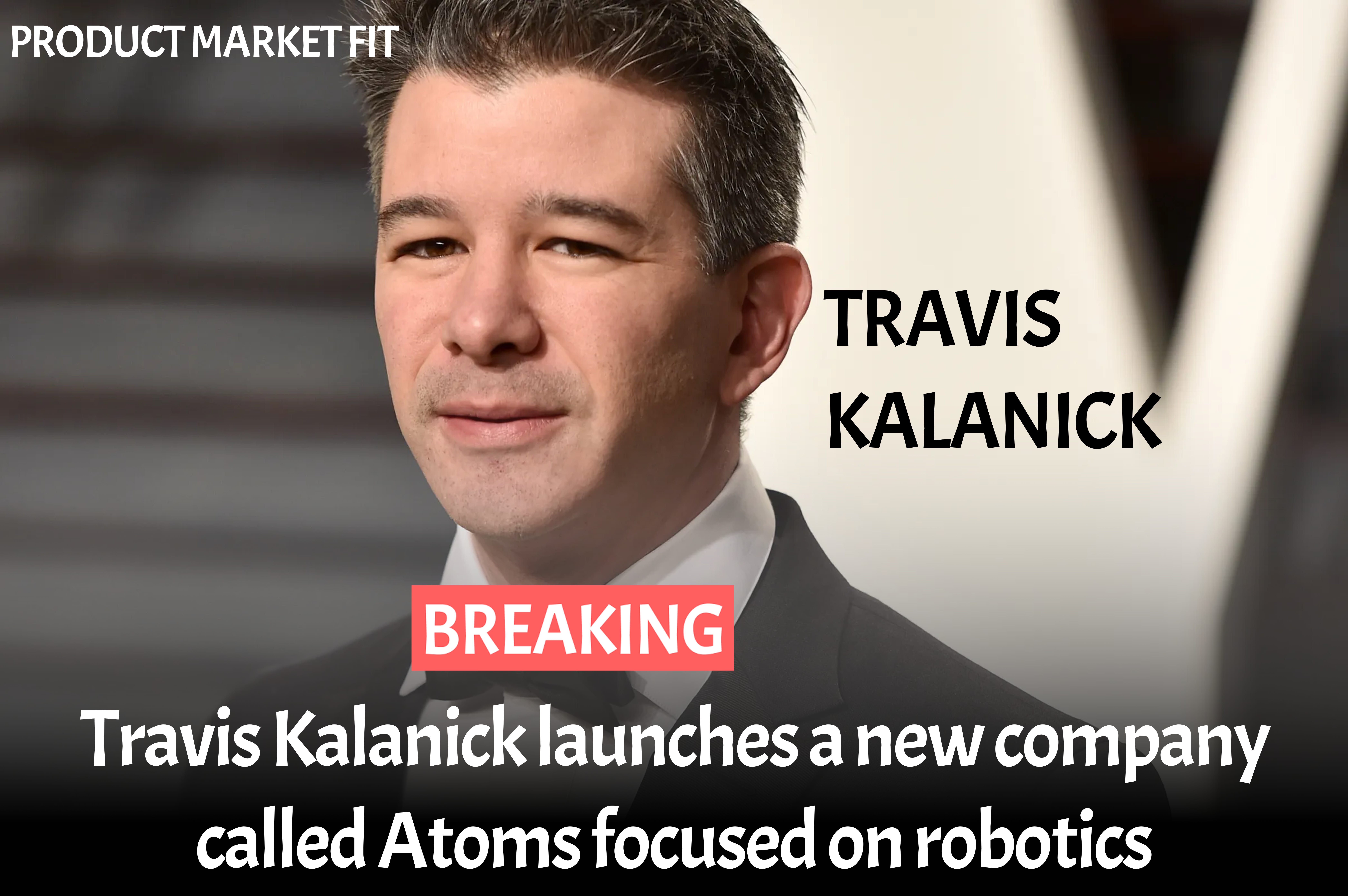
Travis Kalanick is back.
And he did not come back with a side project.
After being forced out of Uber in 2017, he mostly disappeared from the public conversation.
No big reinvention tour. No endless podcast appearances. No public “building in stealth” theater.
He spent the last several years building City Storage Systems in relative silence, and on March 13, 2026, he finally stepped back into the spotlight with Atoms.
Atoms is the renamed and expanded version of City Storage Systems, focused on specialized industrial robotics across food, mining, and transport.
What makes this story much more important is what he is actually betting on.
While a lot of Silicon Valley is still obsessed with general-purpose AI, chat interfaces, and humanoid robots, Kalanick is going in a different direction.
His view is that the real opportunity is not a robot that looks impressive on stage. It is a machine that can do a specific job, repeatedly, in the real world, at industrial scale.
“Humans become more and more valuable because they will be the long pole in the tent to progress and that progress is going to accelerate and get faster and more robust"
While his successors in Big Tech are retreating and treating human headcount as a liability, he’s betting that as the world automates, the right humans will become the most valuable “bottlenecks” in history.
So, I decided to dig deep into what Travis knows that we don’t. In this newsletter, we go through:
The Silent Decade: Why Travis disappeared for nearly a decade, and what he quietly built during that time.
What Atoms Actually Is: Why Atoms is much bigger than just another robotics startup.
Why Specialized Robotics Wins: Why focused machines may end up mattering more than humanoids or generic AI agents.
Humans as the Bottleneck: The deeper thesis behind Travis’s most important idea.
The Vertical Robotics Market Map: The categories already emerging beneath the surface.
The Companies Already Building Here: Who is already operating in these markets.
15 Startup Ideas Still Open: The gaps that still look buildable.

First impressions matter.
With Framer, early-stage founders can launch a beautiful, production-ready site in hours. No dev team, no hassle.
Join hundreds of YC-backed startups who launched here and never looked back.
Pre-seed and seed-stage startups new to Framer can enjoy:
One year free: Save $360 with a full year of Framer Pro, free for early-stage startups.
No code, no delays: Launch a polished site in hours, not weeks, without hiring developers.
Built to grow: Scale your site from MVP to full product with CMS, analytics, and AI localization.
Join YC-backed founders: Hundreds of top startups are already building on Framer.
You’re reading the free preview.
If you want to stay ahead of the VC world and discover the founders and startups actually building the future, you can subscribe here:
1. The Silent Decade
he part that makes this story hit harder is not just that Travis is back.
It is how he came back.
Most founders who leave a company as famous as Uber spend the next few years trying to rebuild their image. They go on podcasts. They write a book. They become investors. They reposition themselves for the next chapter.
Travis did not do that.
He went quiet and started building again.
That matters because silence in tech usually means one of two things.
Either nothing is happening.
Or something serious is being built.
In Travis’s case, it was clearly the second.
Under City Storage Systems, he spent years building physical infrastructure in the background. Not another software layer. Not another marketplace. Actual real-world infrastructure tied to food, logistics, and operations.
That is important because it tells you something about how he thinks.
He does not like sitting neatly on top of an industry.
He likes rebuilding the system underneath it.
That was true with Uber. And it looks true again now.

2. What Atoms Actually Is
A lot of people will read the headlines and think this is just Travis launching another AI company.
That is not what this is.
Atoms looks more like an attempt to build an industrial platform.
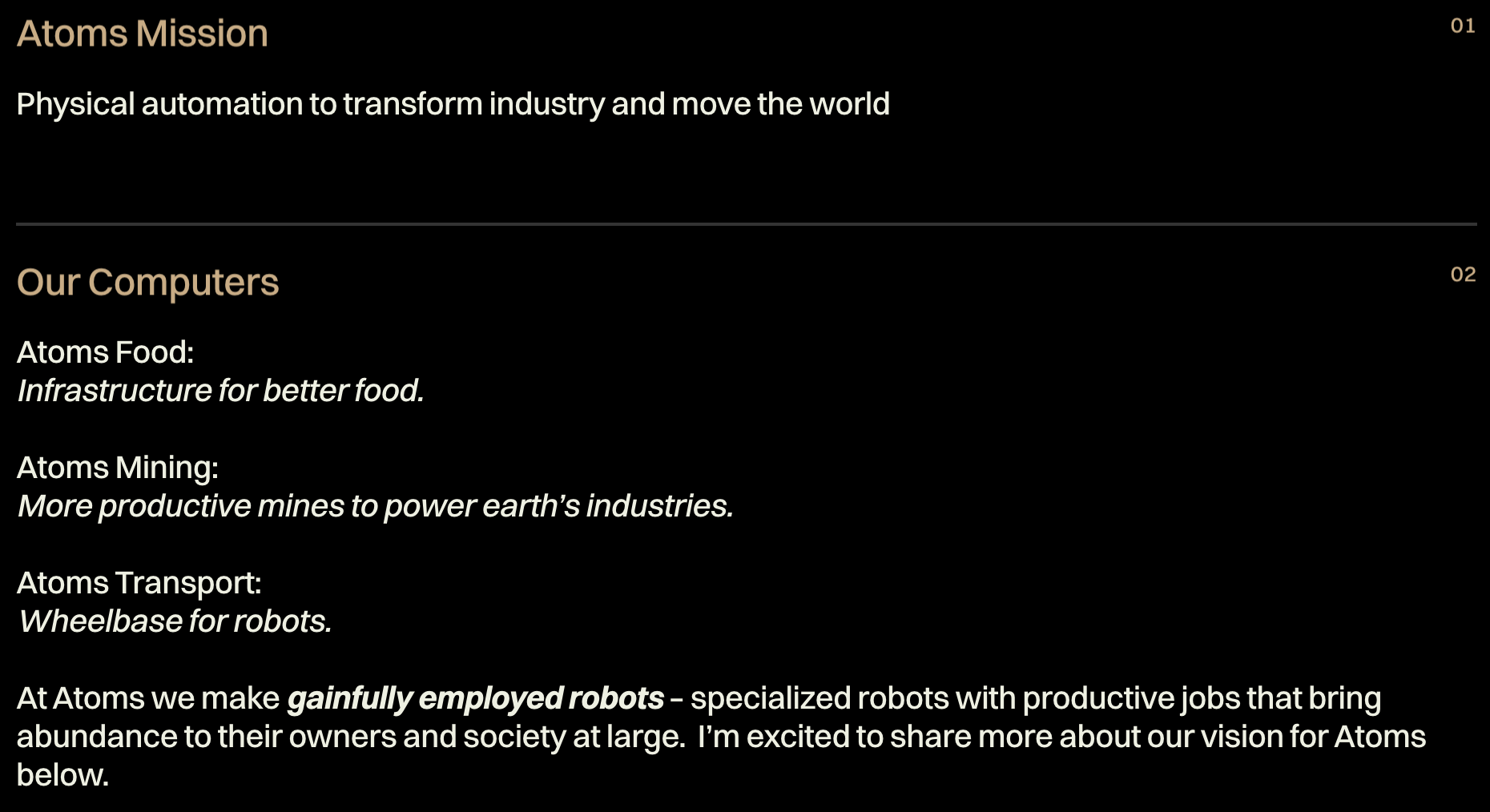
The company is structured around three areas:
Atoms Food
Atoms Mining
Atoms Transport
Atoms Food: This absorbs the famous CloudKitchens and Otter. It features Lab37, which developed the “Bowl Builder” a 19-foot kitchen robot that automates 40% of manual food preparation. The goal: match grocery store economics for prepared, delivered meals.
Atoms Mining: A massive pivot into heavy industry. This division focuses on automating the extraction of materials critical to global industry. Kalanick is finalizing the acquisition of Pronto, an autonomous vehicle startup founded by Anthony Levandowski, to lead this charge.
Atoms Transport: This is the foundational layer. Kalanick calls it the “Wheelbase for Robots.” It’s a standardized mobility platform (chassis, power, sensors) that can be outfitted for any industrial task essentially a “Universal Operating System” for anything with wheels in a warehouse or mine.
Atoms has emerged as a $15 billion “Decacorn” funded entirely in the dark and raising over $1.1 billion. In the captable there is the Saudi Public Investment Fund (PIF) anchored the vision with an early $400M check, and Kalanick himself injected $150M of his own wealth. In a poetic twist, even Uber has surfaced as a major backer, specifically funding the transport division.
The scale is staggering: Atoms now operates in over 110 cities across 30 countries, employing thousands who were “invisible” until last week. Furthermore, the most impressive part was the real estate play. Kalanick spent billions acquiring distressed real estate old warehouses, parking lots, and abandoned retail spaces and converted them into high-tech hubs for his robots.
If robots and software make 90% of a workflow faster, cheaper, and more abundant, the last 10% starts to matter a lot more.
That last part might be:
repair
supervision
exception handling
judgment
on-site adaptation
quality control
final execution in messy environments
