


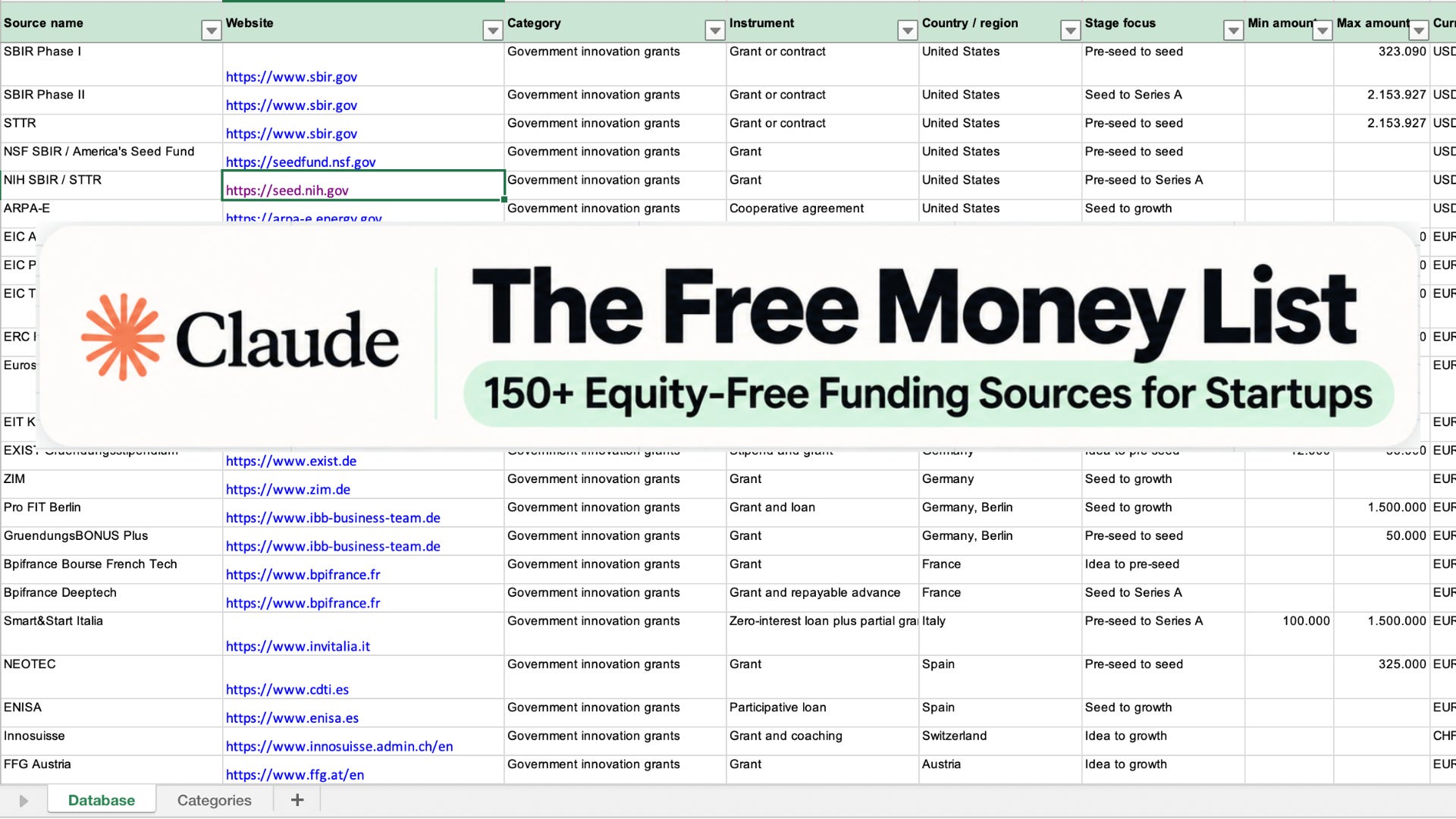
Before you sell 10% of your company, check whether someone is willing to give you the money without taking any of it.
Most founders default to VC because it’s the funding market they can see. But underneath there is an entire layer of startup capital that most founders barely touch: grants, prizes, government programmes, R&D incentives, cloud credits, fellowships and other non-dilutive funding.
The problem is finding the right programs, figuring out whether you qualify and surviving the application process.
So we built both parts:
A database of 150+ funding opportunities
a Claude agent that interviews you, finds the ones worth applying to, and helps write the applications.
Inside you will find:
The Full Database
The Setup That Powers Every Prompt Below
How to Let Claude Interview You Before You Look at a Single Programme
How to Make Claude Pick the Programmes You Actually Qualify For
How to Know If a Call Is Worth Your Forty Hours
How to Get the Application Written Through a Second Interview
How to Catch Every New Call Before the Deadline
+150 Sources Across 9 Categories
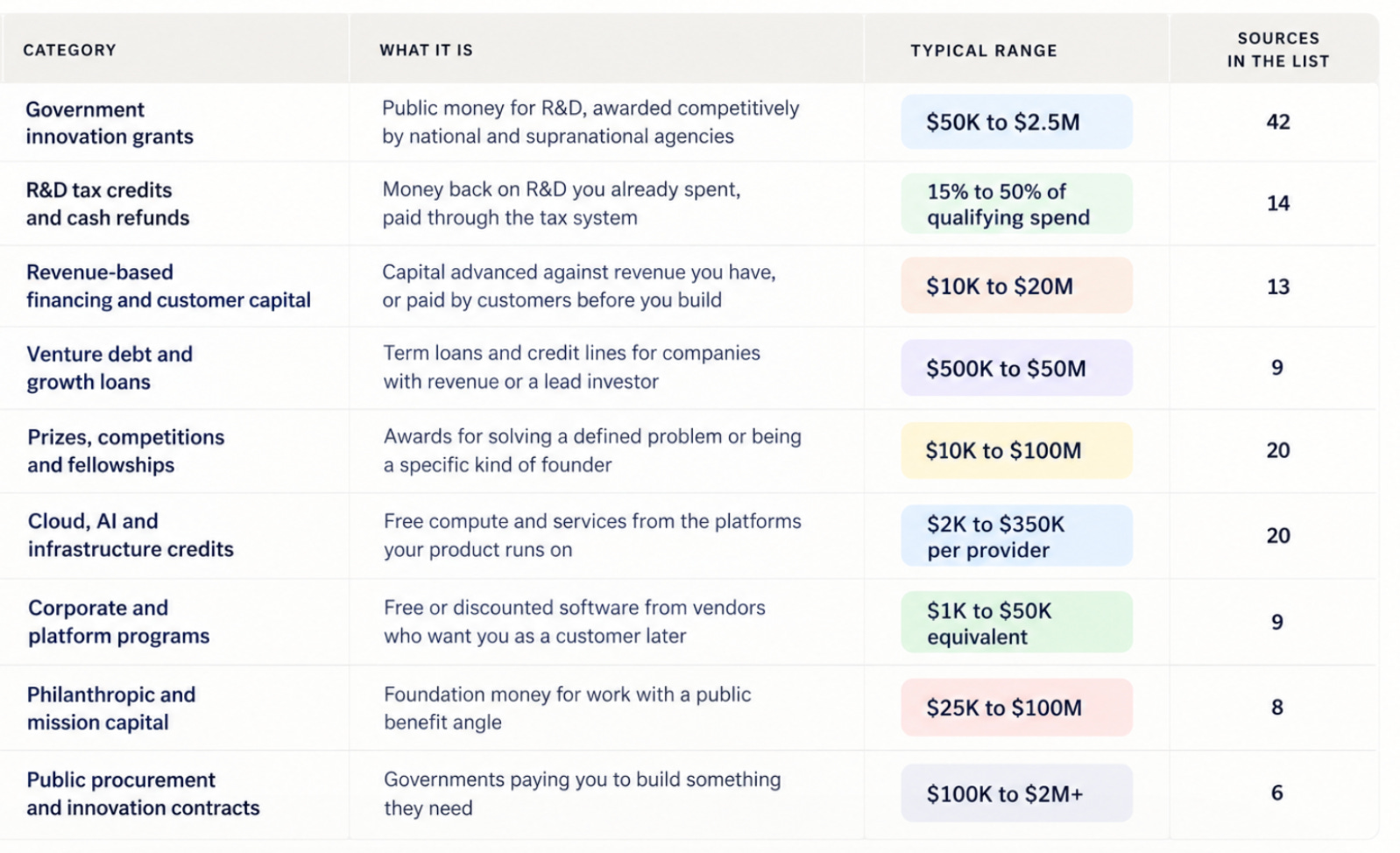
The full database includes 150+ funding opportunities across 9 categories:
Government Innovation Grants
R&D Tax Credits & Cash Refunds
Revenue-Based Financing & Customer Capital
Venture Debt & Growth Loans
Prizes, Competitions & Fellowships
Cloud, AI & Infrastructure Credits
Corporate & Platform Programs
Philanthropic & Mission Capital
Public Procurement & Innovation Contracts
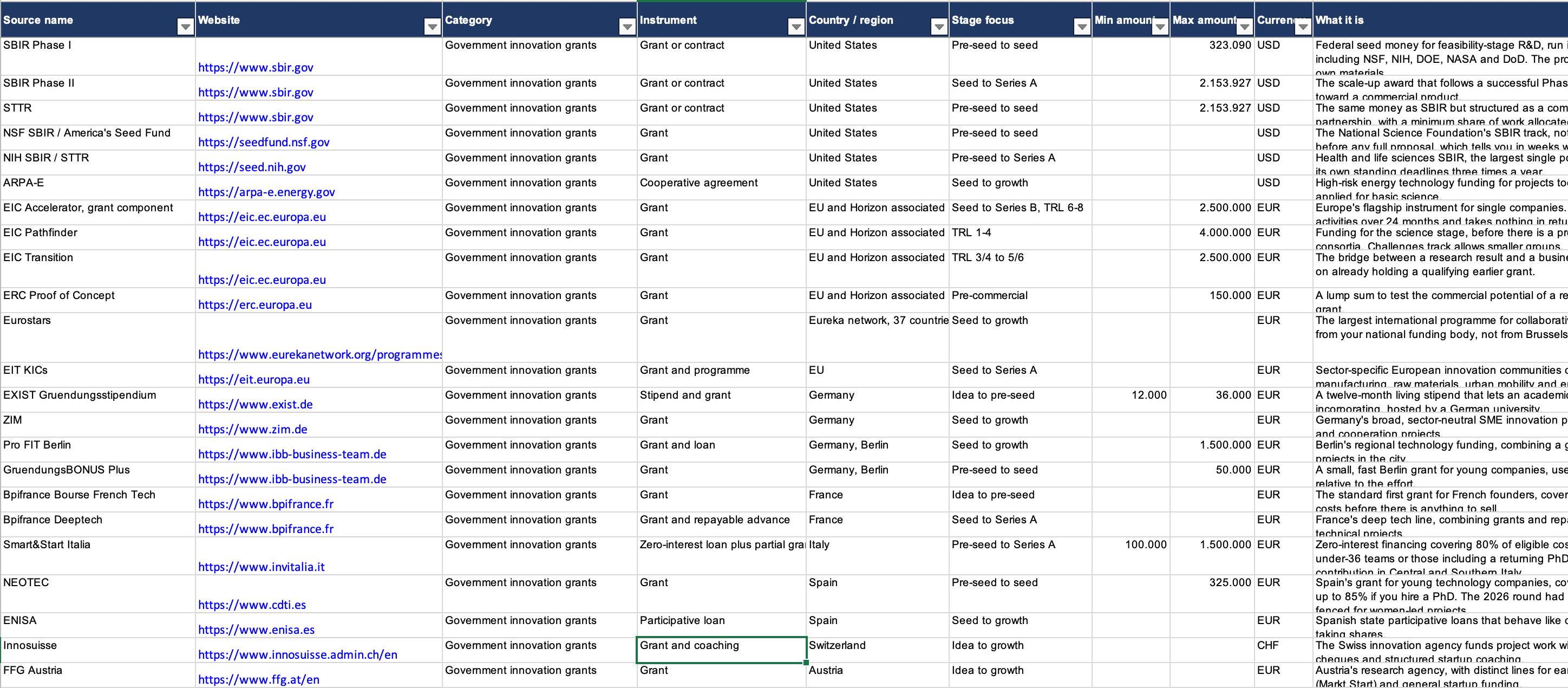
For every opportunity, the database tells you:
Funding source → who is offering the money
Type of funding → grant, prize, credit, contract, R&D incentive, financing, and more
Country / region → where you need to be based or operate
Stage → from pre-seed to growth
Funding amount → minimum and maximum available
What it actually is → a plain-English explanation of the programme
Key requirements → who can apply and what you need to qualify
Deadline / cadence → rolling, annual, or fixed application windows
Time to money → roughly how long it takes to get funded
Best for → the type of startup most likely to benefit
Why Non-Dilutive Capital Changes What You Raise and When
Keeping your shares is the argument everyone already knows. Three others matter more.
Price. A seed round raised on a story gets priced like a story. The same round raised eighteen months later, with the engineering funded by a grant and the infrastructure funded by credits, gets priced on a working product with customers on it. What you save is the gap between those two prices.
Timing. Grant committees do not care that the market cooled. Tax authorities have no investment thesis. This is the one line in your funding mix that behaves identically in a bad quarter.
Signal. Innovation agencies run technical diligence most seed funds cannot staff. Winning one is something a lender will price and an investor will notice.
What Claude Does With This List
There is still one problem. Even with everything organized, 150+ opportunities are too many to review manually.
That is where Claude comes in:
interviews you first. Before you look at a single programme, Claude asks you the twenty-odd questions that determine eligibility across every scheme in the list
cuts the list down to what you can actually win. It runs your profile against all the sources and sorts them into eligible, ineligible and unclear
reads the call documents so you don’t have to. Point it at a specific programme and it extracts the real questions, the published scoring grid and the weights and the profile of who has won before
it re-interviews you to write the application. The second interview is narrower and harder: it asks you the questions the evaluator will ask, in the evaluator’s order, and turns your answers into the application.
Let’s begin!
1. The Full Database 👇
This full database + the Claude agent is available exclusively to paid subscribers!
Paid subscribers unlock the full library: 200+ decks, 10,000+ investors, AI Agent playbooks, and fresh high-signal content every week.
Not subscribed yet? Unlock the full database with a 7 day free trial!
We’re already 80,000+ founders and operators inside!