


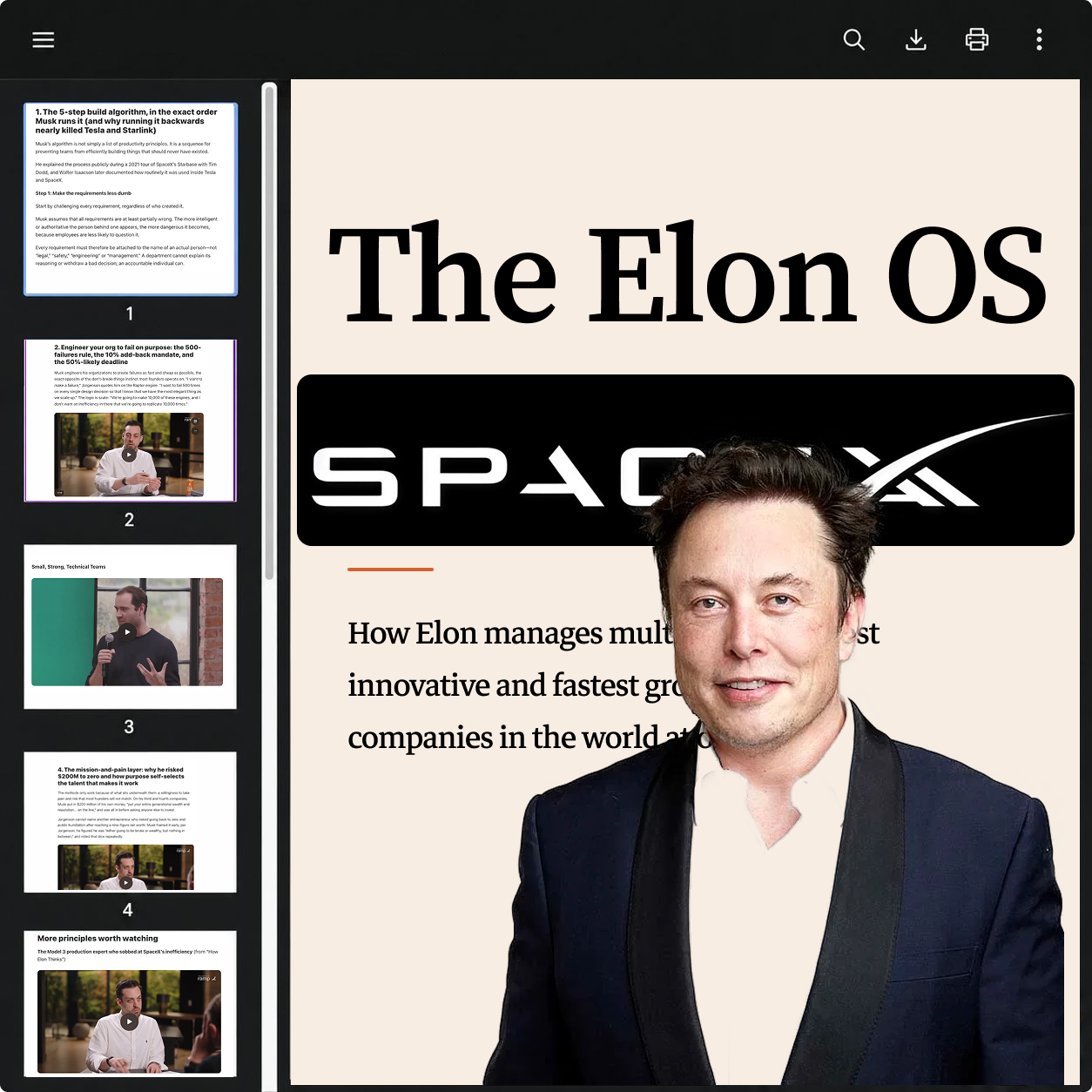
Elon Musk does not outperform entire industries because he works longer hours, hires more people or has access to better technology.
He operates his companies using a distinct system for questioning assumptions, removing complexity, accelerating learning, identifying exceptional talent and concentrating resources on the biggest constraint.
To understand how that system actually works, I studied three of the clearest breakdowns of Musk’s operating methods:
David Senra’s 110-minute How Elon Thinks conversation with Eric Jorgenson, who spent five years and thousands of hours studying Musk to write The Book of Elon.
Relentless’s 102-minute conversation with Sequoia partner Shaun Maguire, Why Elon Outcompetes Everyone, which explores Musk’s talent selection, capital allocation, risk tolerance and ability to compound knowledge faster than his competitors.
And Andrej Karpathy’s talk at Sequoia AI Ascent, where the former Tesla AI leader explained what it was actually like to operate inside one of Musk’s companies—and how small, highly technical teams, extreme ownership and direct access to the underlying work shaped Tesla’s execution.
Together, they reveal something more useful than another collection of Elon stories.
They reveal the Elon Operating System: the repeatable principles Musk uses to build companies that move faster, learn faster and achieve outcomes that initially appear physically or economically impossible.
In this guide, you’ll learn:
The five-step build algorithm, in the exact order Musk runs it
How Musk engineers his companies to fail on purpose
How Musk identifies talent and creates extreme accountability
Why Musk keeps teams small, technical and close to the work
The mission-and-pain layer beneath the operating system
How Musk allocates capital and attacks constraints
The portable Elon OS checklist
👋 Just a quick note before you continue!
From now on, as a premium subscriber, you’ll get access not just to the best resources on fundraising and growth (160+ Playbooks, 65+ Success Stories, 30+ Pitch Deck Collections, 25+ Investor Resources), but also:
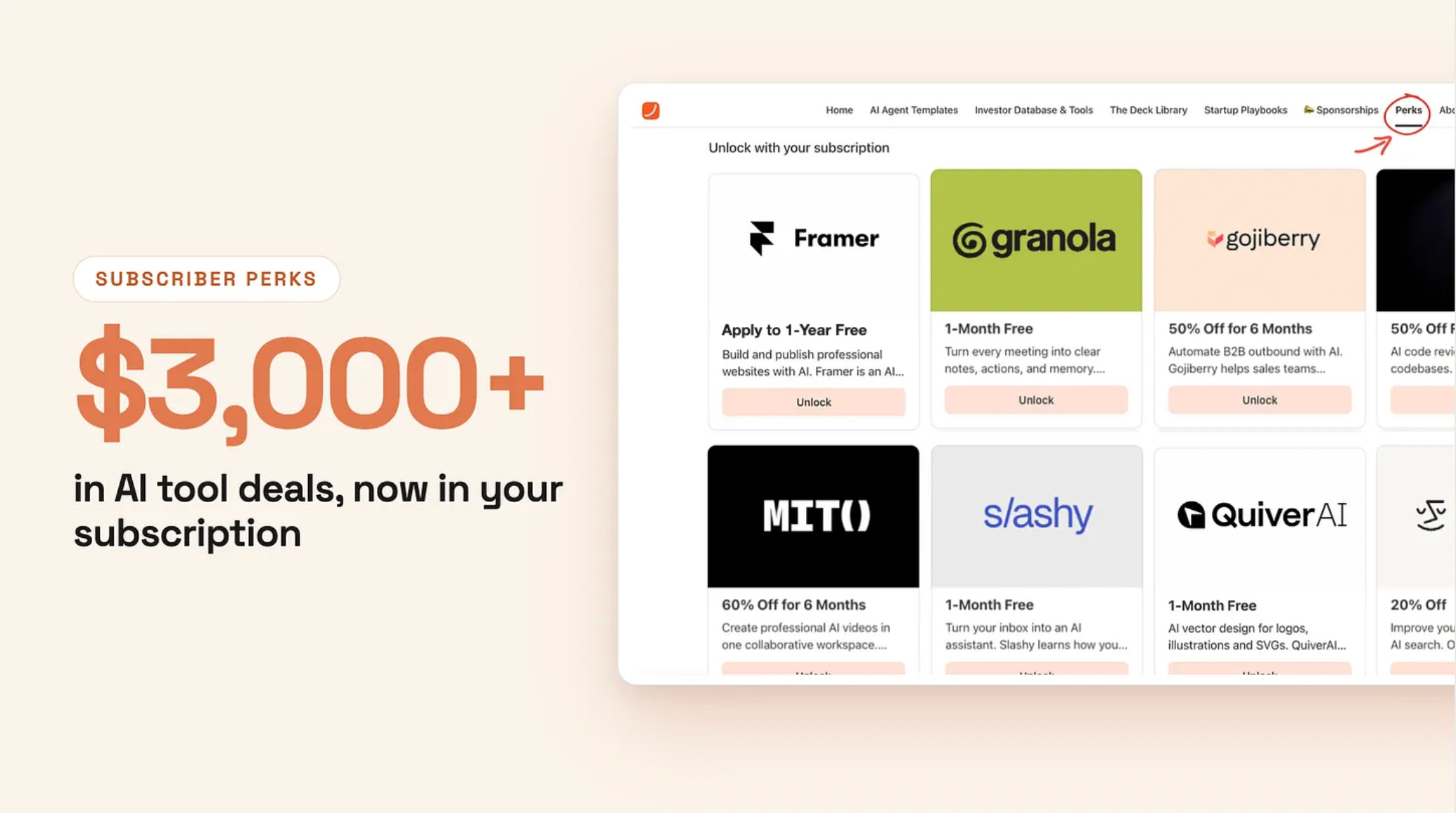
Annual paid subscribers now unlock exclusive deals on the AI tools founders actually use every day.
Here’s what’s live on the perks page right now:
Framer: 1 year free
MITO: 60% off for 6 months
Gojiberry: 50% off for 6 months
Cubic: 50% off your first month
Omnia: 20% off
Granola: 1 month free
Slashy: 1 month free
QuiverAI: 1 month free
Throxy: 50% off for 3 months
These deals are worth more than $3,000.
Here’s a good place to start:
🤖 AI Agent Templates
↳ The McKinsey Slide Playbook for Claude — how to build consulting-grade presentations in minutes.
📈 Startup Playbooks
↳ The AI Founders Playbook — lessons from Sequoia, OpenAI, Nvidia, and LangChain on building AI startups from zero.
🎯 The Deck Library
↳ 27 Most Promising AI Startup Pitch Decks Backed by Top Investors — the best-funded AI startups of 2025, slide by slide.
💰 Investor Database & Tools
↳ The Family Office List — 1,000 family offices actively writing cheques. Used by 5,000+ founders raising their round.
The rest of the article is only available to premium subscribers.
