


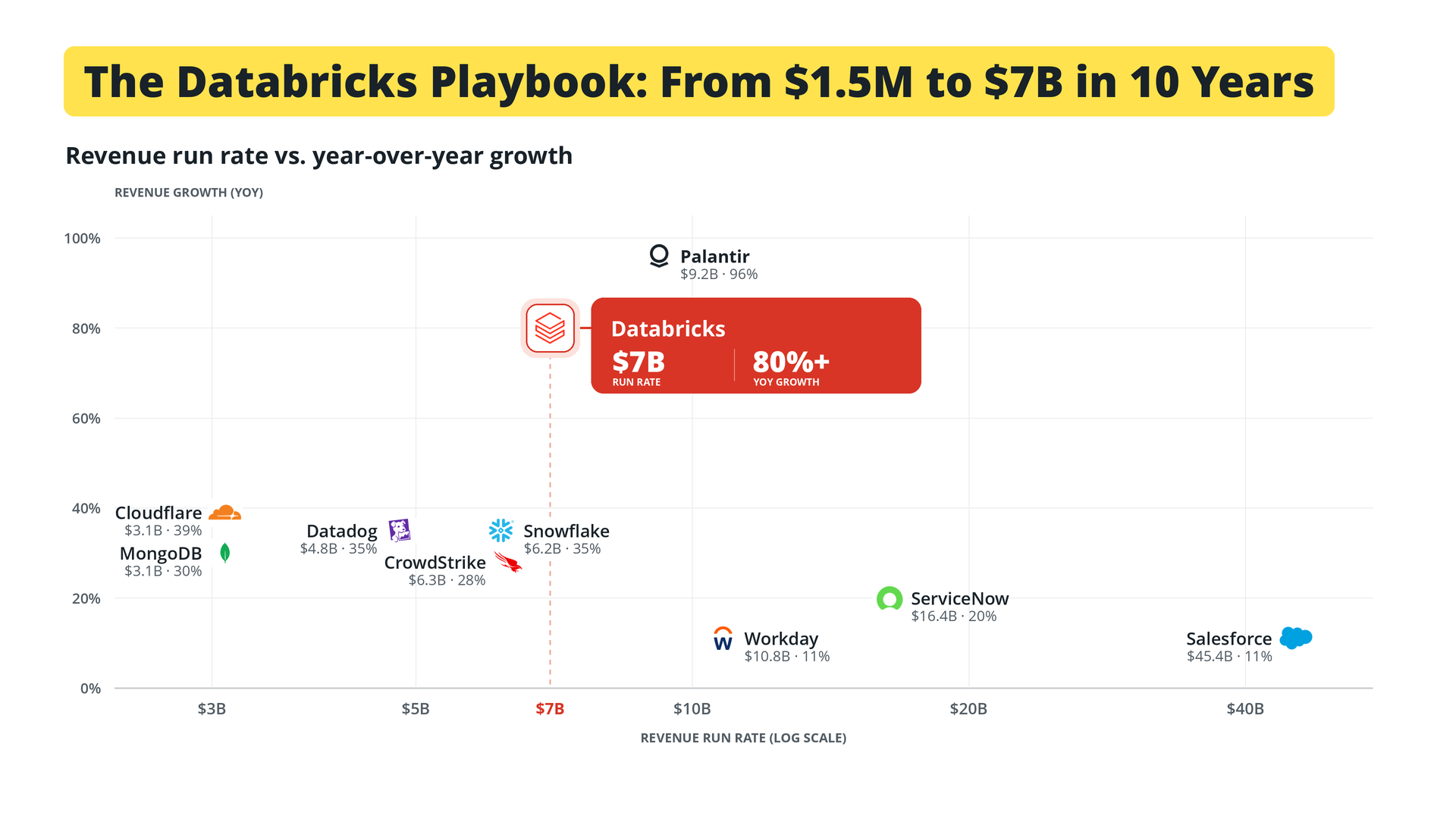
The Wall Street Journal reported that Databricks is in talks to raise at a $225 billion valuation.
Three months ago it raised $5 billion at $190 billion. Since then the Nasdaq has dropped, chip stocks have cratered, and Snowflake, its closest public rival, trades at about $90 billion. Investors want in anyway.
Here's what they're buying:
$7B revenue run rate, growing 80%+ a year
Positive adjusted free cash flow
$1.5B+ from its data warehouse, growing 100%+
$100M+ from Lakebase, its database for AI agents, in its first year
Ten years ago the same company made $1.5 million. Its board was secretly interviewing outside CEOs, and customers wouldn't pay for software they could download for free.
📚 In this newsletter we breakdown how Databricks got from there to here: the operational moves, the founder clips where Ghodsi and Horowitz explain them, and a Claude skill for each move so you can run the same play.
Inside you will find:
Why Investors Will Pay $225B for Databricks: what the company sells, explained from zero, and the three contrarian bets behind it
The Team Behind Databricks: seven Berkeley researchers, a $200K ask that became a ~$10M check, and a CEO hired "on trial"
How Free Open Source Became a $7B Revenue Engine: the zero-touch experiment that flatlined revenue, the sales hire that built the machine, and the Microsoft deal that died 10 times
Claude skill: Enterprise Account Finder
How Databricks Overtook Snowflake: the three-weakness playbook, the "coexist" sales motion, and the category name everyone laughed at
Claude skill: Competitor Weakness Map
How Ghodsi Runs a 12,000-Person Company: one bottleneck at a time, executive hiring with back-door references, and the "Conte Curve" to profitability
Claude skill: Bottleneck Finder
Claude skill: Back-Door Reference Pack
How They Buy Companies and Why They're Still Private: the team-product-financials order behind MosaicML, Tabular and Neon, the 6x offer they refused, and the tender machine that replaces an IPO
Claude skill: Acquisition Screen
This issue is available exclusively to paid subscribers!
Paid subscribers unlock the full library: 200+ decks, 10,000+ investors, AI Agent playbooks, and fresh high-signal content every week.
Here’s a good place to start:
🤖 AI Agent Templates
↳ The Playbook McKinsey Charges $2M For — 12 skills that turn Claude into a McKinsey-level consulting engine.
📈 Startup Playbooks
↳ The $100M GTM Playbook — how the fastest-growing AI startups built their sales and marketing machines.
🎯 The Deck Library
↳ +40 AI Pitch Decks (Ultimate Collection) — the decks behind the fastest-growing AI startups, slide by slide.
💰 Investor Database & Tools
↳ The Family Office List (+ the Claude Outreach System) — family offices actively writing cheques, plus the Claude system to reach them.
Not subscribed yet? Try it free for 7 days and unlock this guide, plus our full premium library:
We’re already 80,000+ founders and operators inside!
Let’s begin!