


Garry Tan, president and CEO of Y Combinator, on what a software team can do right now:
“You can go from zero to 15 mil ARR in about four months with like two or three people and like hundreds of agents, like, you know, a few hundred skill files. Building these agentic systems today, I think all you’re doing is you’re seeing where the bottlenecks are. How do I just instruct the agent to create a piece of software or a markdown file that blows away that roadblock?”
Find the bottleneck. Hand it to an agent. Repeat. That is the job.
Where are your bottlenecks? Answering that with numbers instead of opinions is a six figure consulting job. MBB call it an AI transformation assessment.
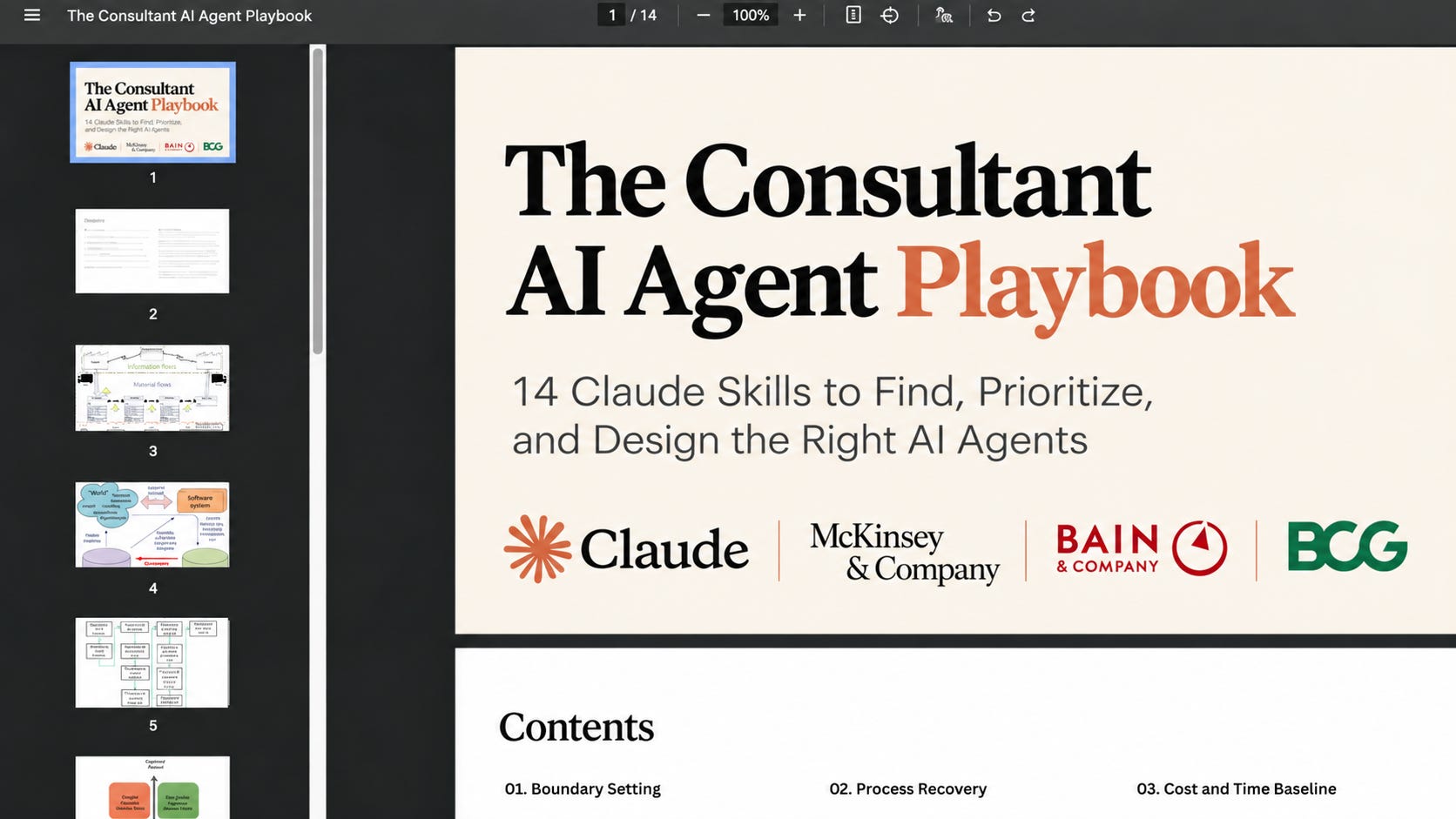
Here are the 14 skills that produce the same assessment inside Claude for free. Every one of them runs on a real framework:
Boundary Setting (SIPOC + Value Stream Mapping, Rother & Shook, 1999)
Process Recovery (Process Mining, van der Aalst; IEEE Process Mining Manifesto, 2011)
Cost and Time Baseline (Time-Driven Activity-Based Costing, Kaplan & Anderson, HBR, 2004)
Tacit Work Elicitation (Critical Incident Technique, Flanagan, 1954 + Contextual Inquiry, Beyer & Holtzblatt, 1998)
Task Decomposition (Task-Based Framework, Autor, Levy & Murnane, QJE, 2003)
AI Suitability Scoring (SML Rubric, Brynjolfsson & Mitchell, Science, 2017; Brynjolfsson, Mitchell & Rock, 2018)
Automation Design (Levels of Automation, Sheridan & Verplank, 1978; Parasuraman, Sheridan & Wickens, IEEE, 2000)
Constraint Analysis (Theory of Constraints, Goldratt, 1984)
Roadmap Sequencing (Weighted Shortest Job First, Reinertsen, 2009)
Benefits Case (Benefits Realization Management, Ward & Daniel + Amdahl’s Law)
Behaviour Specification (Given-When-Then, Dan North, 2006 + ISO/IEC/IEEE 29148:2018)
The Agent Contract (Design by Contract, Meyer, 1986; Hoare logic, 1969)
Failure Design (FMEA + Pre-Mortem, Klein, HBR, 2007)
The Acceptance Bar (Service Levels and Error Budgets, Beyer, Jones, Petoff & Murphy, 2016)
📚 By the end of this guide you’ll have the Claude project that runs the ten skills and hands you the finished assessment: the process map, the scored task inventory, the automation design, the constraint diagnosis and the build specification for the first thing you should automate.
Inside you will find:
How to Set Up the Assessment Inside Claude
How to Map the Way Work Actually Happens
How to Score What AI Can Actually Take Over
How to Turn the Scores Into a Sequenced Roadmap
How to Turn the Decision Into an Agent Specification
This issue is available exclusively to paid subscribers!
Paid subscribers unlock the full library: 200+ decks, 10,000+ investors, AI Agent playbooks, and fresh high-signal content every week.
Here’s a good place to start:
🤖 AI Agent Templates
↳ The McKinsey Slide Playbook for Claude — how to build consulting-grade presentations in minutes.
📈 Startup Playbooks
↳ The AI Founders Playbook — lessons from Sequoia, OpenAI, Nvidia, and LangChain on building AI startups from zero.
🎯 The Deck Library
↳ 27 Most Promising AI Startup Pitch Decks Backed by Top Investors — the best-funded AI startups of 2025, slide by slide.
💰 Investor Database & Tools
↳ The Family Office List — 1,000 family offices actively writing cheques. Used by 5,000+ founders raising their round.
Not subscribed yet? Try it free for 7 days and unlock this guide, plus our full premium library:
We’re already 80,000+ founders and operators inside!
Let’s begin!